To achieve autonomous delivery, I focus on a few core concepts: moving compute off my laptop into background agents and CI, observing agent sessions and how context is constructed, and automating validation.
These let me inspect and improve delivery, then bring what I learn into my consulting work.
Each owned project has a different job. Here is what has shipped, what I can measure, and why it matters to the work I do for clients.
01 / retrieval infrastructure · early traction
hev layer: take retrieval beyond the demo.
I’m working closely with enterprises in healthcare and heavy industry to build features that existing search systems don’t currently include. Layer is a retrieval gateway that works with an existing vector-store API and routes queries across vector, lexical, and hybrid search.
Current snapshot: October 24, 2026. The six showcase apps are chart, hybrid-text, shelf, wiki, lens, and roles. Kit, below, is a separate project. The release count excludes drafts.
The partners give the work a real integration context. The demos make different retrieval patterns inspectable. The next test is quality, tail latency, cost, and continued use on partner workloads.
What I bring to clients: retrieval decisions tested across application patterns, with integration and operation considered from the start.
02 / agent tooling · operating scale
hev kit: make agent work inspectable.
Automated development produces a lot of history. I built kit to search and inspect coding-agent work: recover context, follow what happened, and look for evidence before repeating an investigation. It is both an in-house factory tool and a project built through that factory.
25,389archived agent traces
44.3Btokens recorded, including cache
362,691tool calls recorded
All-time snapshot of my kit archive, October 24, 2026. Tokens include input, output, cache reads, and cache writes: an archive aggregate, not newly generated tokens. These figures describe my own archive, not adoption, completed tasks, or productivity.
In active use in my own practice; external adoption is still early.
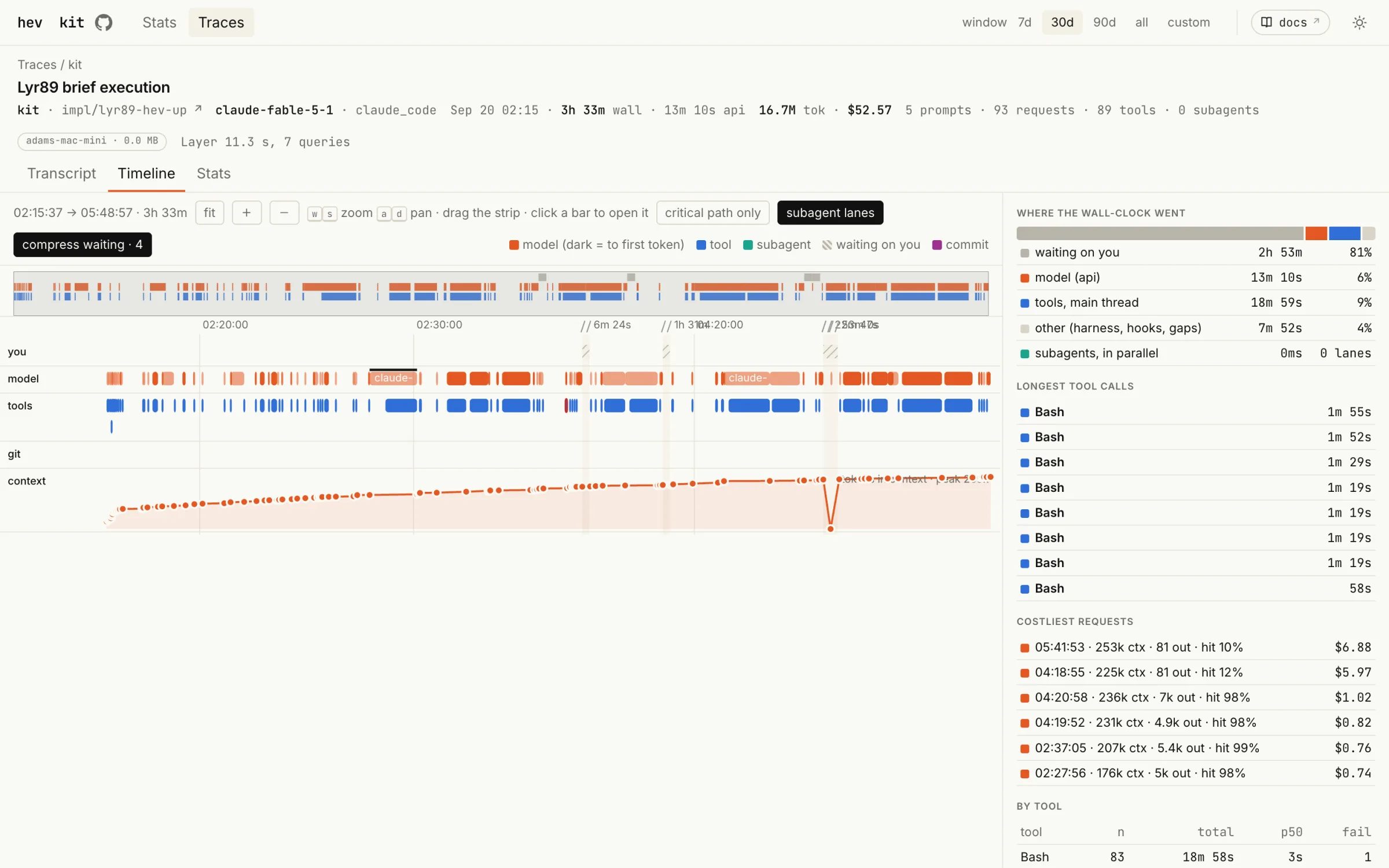
Kit’s timeline view. Public product screenshot from hev.dev/kit; the archive statistics above are a separate, current snapshot.
The aim is a practice that can learn from its own work. An archive only helps when I can find the decision, tool call, or failure that explains the result.
What I bring to clients: treating traceability and context recovery as part of engineering, so agent output can be investigated and reviewed.
03 / reranker research · measured performance
Choose a reranker with evidence.
A model recommendation needs more than a good example answer. I built a benchmark workflow and published comparisons to make retrieval quality, query cost, and latency visible together. The Jev batch run is one concrete result:
0.501mean nDCG@10
$0.54estimated list price / 1,000 queries
223 msmedian latency · p95 ≈ 1.4 s
Published benchmark: SciFact, NFCorpus, and FiQA, reranking the same BM25 top 30. Quality is averaged across the three datasets. Latency reflects the published request conditions; cost is a list-price estimate.
The median looks promising; the tail still matters to an interactive application. Seeing both changes the decision. For an engagement, I would repeat that evaluation on your queries and relevance judgments.
What I bring to clients: an evaluation that makes tradeoffs explicit before a model choice becomes an operating commitment.
04 / travel publishing · a whole product brief
travels with charlie: build for the reader.
A family planning a trip needs useful guidance, a clear place to start, and details they can trust. I built a travel publication around trips we actually took, carrying the brief through editorial content, illustrated art direction, search, and accounts.
9published editorial guides
7destinations covered by guides
Public guide index and sitemap checked October 24, 2026. Nine individual guide pages across seven destination labels; category and utility pages excluded.
The travel brief has its own visual identity, designed around family trip planning.
The intended outcome is helping readers plan trips they can actually take. The publication and its editorial coverage are live; the next useful measures are returning readers and whether they finish the planning task they came for.
What I bring to clients: connecting content, design, and engineering to the person using the product, then choosing measures that reflect their goal.
// cookies
This site uses PostHog to count
pageviews and see which posts land. Nothing is sold, nothing is shared with
advertisers, and there is no session recording. Decline and the analytics never
load. What gets collected.